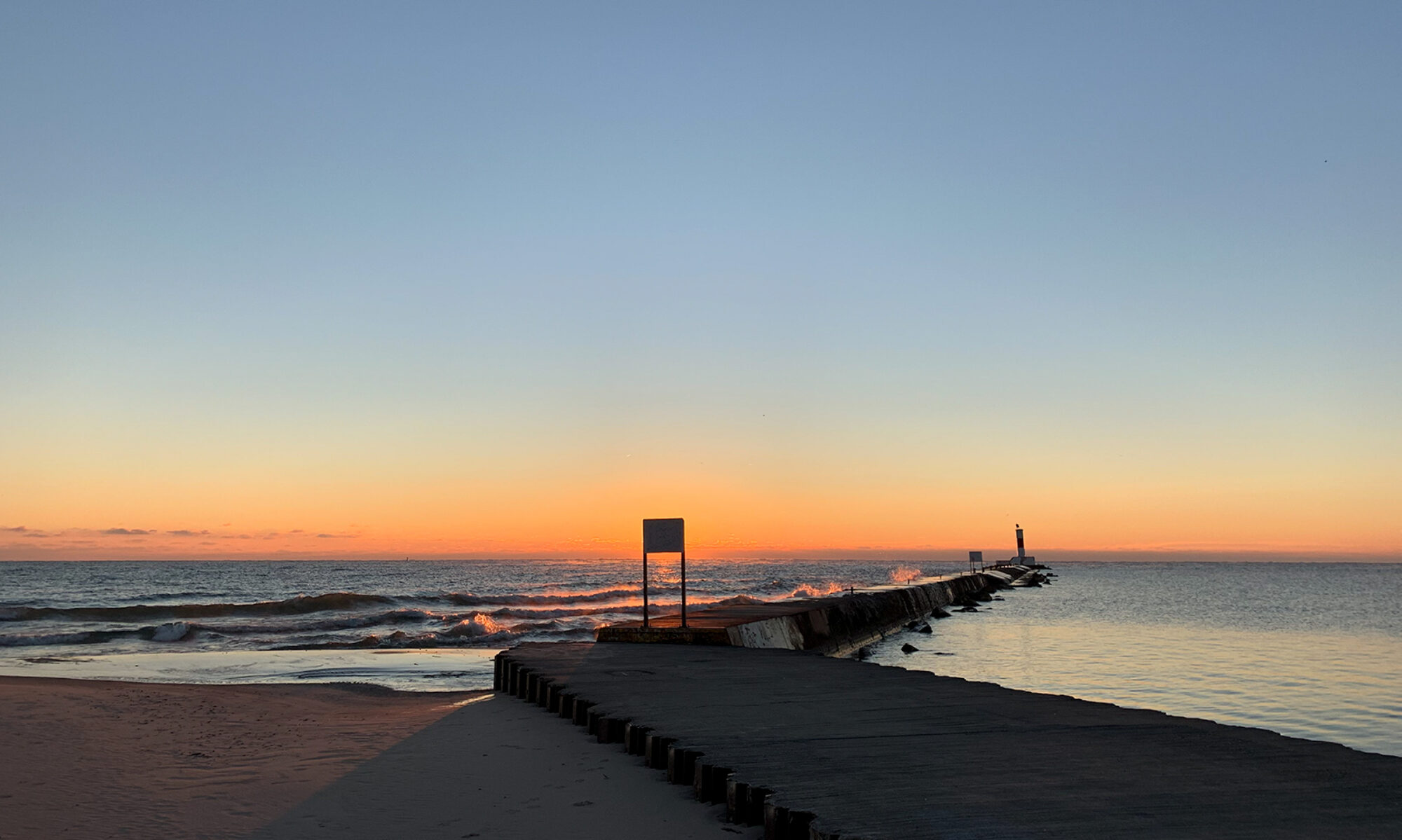
We had a great week-end on the shores of Lake Michigan! I thought you would all enjoy the collection of photos. Send more if you find any.
The resort hotel room was clean and quiet. We had a full breakfast in the restaurant with a view of the beach. We enjoyed seeing our old birding buddies in the nature preserve area.
Waukegan beach was much nicer than we imagined it would be. The entrance was manned by several policemen rather than a lone teenager. The north parking lot only had a few cars and there were only about four other parties widely spaced along the beach. The porta-potties were freshly sanitized and the handwashing station had plenty of soap and water.
The beach itself was beautiful. You all know exactly what it looks like. There were no sharp rocks at the waters edge and it was shallow enough for wading. We had an officer drive by in a golf cart-a friend of Roger’s as it turned out.
In case you are wondering about the simple cookies I made, they are the Italian Ciambelline Campagnole or Country Ring Cakes. They are simple to make and easy to take along anywhere. They are not very showy however.
Heat the oven to 325º. Mix equal parts sugar, red wine and olive oil. I used 3/4 cup each. Add flour until the dough comes together but is still very soft, but not too sticky. Here I used about 4 cups. Let the dough rest 20 minutes. Take a chunk of dough and roll it into a snake about 12″ long. Twist the snake around itself then form a ring and pinch the ends together. Arrange on a greased cookie sheet. I used a silicone pan liner. Bake until they are slightly browned on the bottom. Some people make this with white wine. There are other variations using cinnamon or anise or the addition of raisins or other dried fruit. I kept mine simple.
After a 50 minute flight from Kauai, we grabbed a rental car and headed to the Royal Kona resort. You remember this hotel from last October. We had a beautiful room on the ground floor, with a private patio at the ocean’s edge. Directly next to the low patio wall was volcanic cinder, sharp and rough. We were now on the west side of the island and would not be viewing the beautiful sunrises we saw on Kauai. But the clouds were still colored at sunrise.
From our patio
Saturday, 2/24/ 2024
The pelagic birding trip had been cancelled because too few people had signed up. We were offered a whale watching trip, but after the snorkeling experience we declined. This gave us the day to visit Hawaii Volcanoes National Park. It was a two hour drive from the hotel so we arrived around mid day.
The vastness of the volcanoes is difficult to comprehend from the ground. The sign that Little Pig was reading gives some idea of the scale. It was overcast, chilly and windy, unlike the tropical climate we enjoyed at the coast. We didn’t hike into the craters to see the steam vents. We were more interested in hiking through the Ohia Forest, on the east slope of the volcano. The east slope was completely different climate and habitat than the west side of the park. It was the rainy side, thick with lush vegetation. The trail was a steep descent, starting with a staircase that led down through giant ferns and tall trees. As it was raining on and off the trail had some slippery mud in places. It was a popular trail so we had a lot of hikers moving past us as we took our time birding. The Ohia tree is the favorite of the honey creepers. We could hear them above us, singing loudly. We finally got a visual and identified them as Apapane, the red, white and black bird that is most resistant to mosquito-borne diseases. They were everywhere. We counted fifty but I’m sure there were more. The only other interesting bird was a Hawaii Amakihi, also a honey creeper.
Crater Rim Trail
Crater Rim Trail
Crater Rim Trail
Crater Rim Trail
Crater Rim Trail
The foliage was dense and the birds were at the tops of the trees feeding on the blossoms so we didn’t get photos, however, we got well acquainted with their song. We hiked back up the mountainside and headed back to the hotel. We ate at the resort restaurant, seated within view of the ocean. It was breezy but not as wet as the rain forest.
Sunday 2/25/2024
We woke early and looked outside to see a beautiful moon set.
Dad’s Photo
After relaxing in the room we had breakfast at the restaurant. I finally had an Aćai Bowl. It was so smooth and creamy, with lots of fruit on top and a dab of poi. While we were eating the waitresses were all gathered together and sounded very excited about something. Finally we realized that there were hump-backed whales visible from where we were sitting. They were very active, breaching and tail-slapping. It was a real show, with no boat ride needed!
After breakfast we explored the jagged lava that made up the shoreline. There were small dark crabs clinging to the rocks. One larger crab was busy eating a smaller gray crab. We walked to the hotel’s Salt Water Lagoon. There was a small sandy beach area set back from the rocky shore. The sea water washed in through the rocks and made a quiet lagoon for swimmers and snorkelers who preferred a natural setting over the sterile pool of the hotel. There was a lot of activity out in the bay. There were long, narrow canoes with multiple rowers, some appeared to be racing. There were fishing boats and snorkeling tours and probably whale watching tours.
Later, we went to Kaloko-Honokōhau National Historical Park. The park is the site of ancient fish ponds built to trap fish from the ocean. This was also a site where fresh water was available to the ancient peoples. The landscape is eerie, with jagged lava cinders covering most of the area. At one point on the trail are there are even some petroglyphs. Only Hawaiian Natives are allowed access to the ponds from the main trail so we continued to walk around to the shoreline.
The first part of the shoreline is an ancient lava flow. The crevices were filled with tiny fish and sea creatures. In the deeper spots there were sea urchins. But the stars of the show were the giant sea turtles. They crawl up onto the rocks and beach to sit in the sun. They were very impressive in spite of remaining motionless. A long beach lay beyond the rocky shore. The sand on the beaches here is a very coarse sand that hurts your feet if you walk barefoot (at least it does with a fresh pedicure). From the dune behind the beach you could get a closer look at the pond. We saw a variety of shorebirds and waterfowl, some of them Hawaiian versions of our regular Midwest species.
We drove back south to find dinner and spend our last night at the Royal Kona Hotel. We had to get organized and packed up because early Monday morning we had to meet our guide, Lance Tanino to visit the Hakalau Forest-the epicenter for honey creepers!
Monday 2/26/2024
We got an early start. Travel time to the meeting place was 1 hour and 15 minutes and we did not want to be late. Joining us on the tour was a younger couple. Five pairs of eyes! As the guide warned us, it would be cold and rainy in the cloud forest. I wore most of the long sleeve things I brought and did not regret it. Dad had rain pants in addition to his raincoat. My ancient raincoat, which spent most of it’s long life rolled up, started shedding it’s inner lining, getting tiny white flecks everywhere. But it managed to keep the most of the rain out. The rain was a constant fine mist with intermittent showers. We had our cameras with us so trying to keep them dry was a distraction. This hike took all day. At lunch time we stopped at a shack that in previous years had been used by researchers. It was old and dusty and decorated with Hawaiian Goose droppings but it was a place to eat our Bento boxes out of the rain.
The rain seemed to keep the birds down. We saw some of the target birds, but not all of them and some did not give good looks at all. The Apapane was easy to hear and see, probably the most abundant of Honey Creepers. We got glimpses of Hawaii Elepaio, Akiapolaau, and Hawaiian Creeper. Due to the circumstances, Dad did not get a good look at the poster bird, the I’iwi. At about 2:00 we hiked back to the entrance, wet and tired. After Lance took us back to our cars we followed him on a brief driving tour and saw the Hawaiian Short-eared Owl over some grassy fields. It looks just like our Midwest Short-eared Owl.
It was time to check in to our new lodging, a B&B on the north east side of the island. I later found out that this was the “rainy side”. Great. We had a little room in the attic that in B&B parlance would qualify as “cozy”. Barely enough room to turn around. It didn’t matter because we would not be spending much time in the room anyway. The place had friendly owners and a lot of foliage on the grounds. There were amazing clumps of very tall bamboo trees. We found out later that they had only been growing 15 years. Yikes!!
Tuesday 2/27/2024
We were up and out the door by 6:30 am to meet our guide. This was a tour of West Hawaii. I was grateful that it was a roadside type tour that involved little hiking. And grateful that the west side is the dry side. The birds seen were mostly non-natives and others birds that populate parking lots and golf courses and other spots that are easy to access. The highlight of the trip was the Mountain Thunder Coffee Plantation. This spot had a lovely little botanic garden featuring many tropical plants and other cultivated plants like fruit trees, coffee trees and banana trees. The star of the show birdwise was the endemic Hawaiian Hawk. They were high in the sky but there were three of them giving good views. We continued on, visiting small parks, filling stations and, of course, the wastewater treatment plant. Our last stop of the day was the Macadamia nut company. The nuts are processed there and the hulls are dumped in back of the plant in huge piles. All the birds from nearby spend time on these piles seeking bits of nuts and insects. There were no rarities but you never know. At one point on our travels we were able to see the telescopes on Mauna Kea. “The Mauna Kea Observatories are a group of independent astronomical research facilities and large telescope observatories that are located at the summit of Mauna Kea on the Big Island of Hawaiʻi, United States. The facilities are located in a 525-acre special land use zone known as the “Astronomy Precinct”, which is located within the 11,228-acre Mauna Kea Science Reserve.” -from hawaii.edu. The map does not show this spot.
Wednesday 2/28/2024
The bed and breakfast was the traditional style, meaning they serve breakfast at 8:00 am. We weren’t meeting our guide that day so we could take time for a leisurely breakfast and chat with our hosts. After that we drove north on the east side of the island to a few lookouts. There was beautiful scenery but no new birds. We stopped at a gallery and saw a lot of hand crafted items, including beautiful bowls carved from local wood. After lunch we crossed the island and drove to the lookouts facing west.
Thursday 2 29 2024
We were up and on the road early to meet Lance for the last scheduled tour. The plan was to cover the Kohala area of the island, the thumb-shaped northern penninsula. We had already seen many of the scenery attractions the previous day but Lance would see it from a birder’s perspective. We began at a small botanical garden. This did not have a lot of birds but Lance pointed out many of the native plants that grow on the island. We continued on, counting roadside birds as we went. At 9:00 we began a sea watch from a look out on the east side of the peninsula. We stayed for 3 hours. The birds that we saw were the same birds we would have seen from the pelagic tour, but we were safely on land. The showstopper, however, was the Hump-backed whales. They were very active, breaching and tail-slapping and even waving their flippers. Lance identified a mother and her calf.
We carried on after lunch, making brief roadside stops for non-endemic species. As we road east with Lance, we saw a beautiful rainbow. When we got to the end of the rainbow all we got was rain. We headed back to Honokaa, the closest village to our B&B. We chose a nearby bar for dinner just so we could avoid another long drive. There was a lively trivia contest going on and Dad got every question right, even though we weren’t playing.
Friday 3 1 2024
After breakfast our host gave us a tour of the grounds of the B&B, which had some beautiful plants. Many were ornamentals and non-natives. We checked out of the B&B but our flight home didn’t leave until 11:59 pm. We had a whole day of birding on our own. I wanted to return to the Mountain Thunder Coffee Plantation to give Little PIg some quality time in the botanic garden there. We were also hoping to see the Hawaiian Hawk again. After taking photos of the plants we went to the look out to look for hawks. We looked up and right over us, perched in a tree was an immature Hawaiian Hawk!! We took a bunch of photos and then spotted two others nearby. Identifying the bird is easy since they are the only hawk on the island.
We revisited a few of the spots along the shoreline. We had a late dinner at the airport and finally quit making eBird reports. We had a great time but were exhausted. Time to go home and recover!!
Good morning from Kauai! We are on the east side of the island and the sunrise is visible from the tiny balcony of our hotel room. We’re up bright and early because at 8:00 am we will tour Kauai from a private plane. We meet our pilot, Piper, at the airstrip designated for small planes. She is 22 years old and is named after the famous airplane manufacturer. We were happy to know that she has been flying since she was 16 and very comfortable with the task of taking us over the island. I was thrilled when she invited me (and Little Pig) to sit in the cockpit.
The scenery was amazing. The photos you see of Kauai seem somehow unreal, but it really looks like this. The movie Jurrasic Park was filmed in these jungles.
After a safe landing we drove to Waimea Canyon State Park. Here we saw from the ground some of the scenery we saw from the air. The park website description:
Waimea Canyon State Park, aptly named the “Grand Canyon of the Pacific,” unveils a breathtaking panorama of deep red and green gorges, showcasing the geological marvels that have shaped Kauai’s interior.Explore the diverse landscape with hiking trails leading to hidden gems like Waipo’o Falls, an 800-foot waterfall, and panoramic viewpoints within the untamed beauty of the canyon.
Waimea Canyon State Park
White-tailed Tropicbird
Apapane
ʻōhiʻa lehua, is a species of flowering evergreen tree in the myrtle family,
Adjacent to Waimea Canyon State Park is Koke’e State Park. Here we got our first sighting of the Apapane, a honeycreeper, and the White-tailed Tropicbird. We’ll get a closer look at both of these species later. We got back to the resort in time for Mai Tais and dinner.
Wednesday 2/21/2024
Our goal today was to visit Kilauea Point National Wildlife Refuge. The point is located on the north side of the island, east of Princeville. There is a lighthouse on the point and a sweeping view of the the ocean and nearby cliffs. These cliffs are the nesting site of hundreds of Red-footed Boobies. They appear as white dots covering the cliff. Also, the Laysan Albatross and the Hawaiian Goose nest nearby.
Kilauea Point Lighthouse
Red-footed Booby
Red-footed Booby
Laysan Albatross
Laysan Albatross
White-tailed Ttropicbird
Red-tailed Tropicbird
Laysan Albatross
When we finished at the park we continued north past Princeville. The roads are narrow, winding and the smaller bridges crossing the streams are one-way. There is always road work so the going was very slow. At the end of this road was another state park. Sadly, I hadn’t planned ahead so we did not have the reservation needed to access the park. There were plenty of tourist spots along the way, even in what seemed like a difficult to reach spot. We finally found a lunch place and had a well deserved rest. The ride back to the resort was slow and uneventful. We had dinner at the resort after witnessing a lighting of the tiki torches observance.
Thursday, 2/22/2024
Today we had a leisurely breakfast and spent some time in our room organizing and looking at our photos. We had a tour booked at the harbor at 11:00 so we headed out about 10:15 to get there early. We were going snorkeling! It seems that every must do this because there are snorkel tours everywhere. We got to the rendezvous area and listened to all of the explanations of how to wear the safety vest and how to put the mask on. We got into a wetsuit jacket tried on our flippers. Then we drove a short distance to the boat. This boat was an inflatable boat with a large outboard motor. We were going out into the open ocean! There are no photos of this because we left all cameras and phones behind. This trip was called an adventure but I assumed that just meant you had to get out of your chair. But it really was an adventure. Oh, No!!! Just getting out of the tiny harbor was extremely rough. We were sitting on the edge of the boat, hanging on to some lines that ran along the inside edge of the boat and putting our toes under another line that ran along the floor of the boat. No flippers yet. The water was very choppy as we got out to sea. Yes, sea! Finally the captain found a spot for us to snorkel. It was time to actually get into the water. Well I got the flippers on and sat onto the edge of the boat. The next step was to get in the water. I didn’t have the courage but finally the captain and a guide managed to get me in. It was salty!! I had an oblong life preserver stretched across my chest and held under my arms. Then my kind guide had a boogie board that I held onto the whole time. She was very patient and talked me into getting my face in the water and looking down. Of course both Dad and I had our glasses off but, unlike Dad, I could actually see something. So finally I got the snorkel mouth piece arranged and I actually breathed through it. So, breathing and looking down and hanging onto the life preserver and the boogie board. I was pretty busy. Below us I could make out sea urchins!! And once in a while a few fish. The guide swam down and came up with a sea cucumber for us to look at up close. Then I spent more time actually snorkeling. There were sea turtles around us. One I saw a little ways away then one swam right under me! It was really awesome. Then I looked up and saw Dad. He was with the other guide. I could see right away that he wasn’t having fun at all. His mask was off and he was just hanging onto the other boogie board. It was time to get back on the boat. I won’t explain the undignified proceedings that led to my finally getting up the little ladder and back to my spot on the edge of the boat. We motored to another spot to do a little more snorkeling. I stayed on the boat with Dad and another young man. Both he and Dad were sick and the motion of the boat was significant. I stayed to be with Dad and to avoid the indignity of trying to get back into the boat again. Hanging on to the line while the boat was moving had made my arms shaky and I feared I would not have the strength to pull myself up. The guides at this point offered us snacks! No takers. Finally we made it back to the harbor. We disembarked and Dad went for a little walk on the pier to adjust to solid land. Another couple on the tour (six tourists in all) were very experienced snorkelers and commented that this was not an easy trip. We were shaken and exhausted. It was all Dad could do to drive 15 minutes back to the hotel. As we took the elevator up to our room a friendly man asked “How are you?” We burst out laughing and told him of our experience. He commiserated with Dad, saying even as a commercial pilot, he gets air sick if he sits at the back of the plane. Dad took a well deserve nap while I ate a snack and rested on the balcony. We will never do this again but for me maybe it was worth it!
Friday, 2 23/2024
Having recovered somewhat from our adventure, we packed up to prepare for our flight to the Big Island. We wouldn’t leave until 5:10 but we had to check out of the hotel that morning. We birded some local spots, not with any great expectations, but then heard about a Gray-tailed Tattler seen at a Salt Pond. The Salt pond
We had a busy week! Tuesday evening Marge arrived from California. She flew into Madison and rented a car to drive here. We had a late dinner of shrimp and Leek Potato Soup, my favorite. We had a nice evening catching up and got to bed a little late. After eating a Frittata for breakfast the next morning we took a tour of the lakefront. It was a nasty, drizzly, windy day and the lake was at it’s best! Giant waves were crashing everywhere, and whitecaps were visible as far as you could see. It was definitely a driving tour.
Downtown we stopped at the kitchen shop and of course the chocolate shop. Then we had lunch at Field to Fork. They have a new fall menu that included Gyros. I had mine served on spinach. After lunch we drove out to Kohler and checked out the fancy shops. There are always things we want at Woodlake, the grocery store, and I like to keep track of the little gift shops. After shopping we had some downtime at home. Finally we settled down for an early dinner at Trattoria Stephano. It was fun to sit and drink Negronis in a cozy restaurant and have a pleasant meal. By this time it was evident that Marge was losing her voice. She said she felt fine so we didn’t worry too much. By breakfast the next morning Marge decided she had a cold. What a shame to have to visit her friends in Madison when she’s sick. She had just come back from a solo trip to Istanbul, so maybe she was just worn out. She left shortly after breakfast.
Friday morning we took off for Chicago. We were going with Doug and Lisa to Symphony Center to see the renowned violinist, Maxim Vengerov, play Prokofiev. We left Sheboygan around 9:00 with plans to stop in Waukegan for Leno’s Subs. Dad had loaded the app on his phone. So on the way I was able to order the subs, complete with changes in the cheeses. The app has a long drop down menu-mainly because now every style of sub is also listed as a salad. After paying for the subs online all we had to do was pick them up. We got to Doug and Lisa’s around noon. We celebrated Doug’s birthday by giving him a pencil drawing of the Edmund Fitzgerald, and thanks to Roger, a six pack of Edmund Fitzgerald Porter. By 3;30 we were getting organized to go downtown. We wanted plenty of time to park, walk to Miller’s and eat before the concert. It all worked smoothly. The program started with works by Clara Schumann, Brahms, and Robert Schumann. These works really showed off the skill of the pianist, Polinas Osetinskaya. The children in front of us were restless and very distracting. But during the second half they had moved to different seats so it was much better for us. The Prokofiev pieces were both pieces I knew very well. It was so exciting to hear them done so beautifully by such a master. In the end the performers received a standing ovation. That resulted in an encore. In all there were four encores, all of them Russian. The drive home was easy. We had some of Lisa’s yummy pumpkin bread and called it a night.
In the morning Lisa was back in the kitchen, this time making squash hash. It was very healthy and filling. We relaxed rather than do any more Chicago activities. We got home in plenty of time to make dinner.
Stay warm everyone, we’ll see you all for Thanksgiving!!
Our hotel here was the beautiful Royal Kona Resort in Kailua-Kona. The lobby and restaurant were open air and right next to the ocean. Unlike Oahu, the coast here was composed of jagged lava and beaches were small and few. Most of the swimming was done in the pool. There were gigantic wooden carvings representing the ancient Hawaiian gods scattered around the common areas. The grounds were beautifully landscaped with a large fishpond and waterfall in the entrance.
So by 7:30am we left this lovely spot to see the water treatment plant, then the skate park and then the cement plant. We added a few new species at each site but they were all naturalized and not native to the islands. We did some roadside birding and finally made it to the Palila Forest Discovery Trail near the middle of the island. . Palila is the name of the bird you can expect to see here. It wasn’t cooperating that day so we missed it . But we did get to see the Hawaii Amakihi and the Hawaii Elepaio, both endemics. I had a few minutes to relax on the balcony after dinner.
We got up early the next morning so we could be at the harbor by 6:15. We were going on a pelagic tour! Little pig was prepared with his life jacket! I was prepared with sunscreen and ginger candy and a big hat. The birds we saw were listed in one hour segments. Each list has a unique location and shows up in your eBird report with a track. The map at the top of the page shows these entries as blue dots out in the ocean. The vessel was a small fishing boat, just big enough to hold eleven passengers and two crewmen. As it was a fishing boat there was also some fishing going on from the back of the boat. The crew has been taking our guides and company out routinely so they were adept at getting to where the birds were. There are very few gulls in Hawaii and it was odd to be on the water and not see and hear them. The big Wedge-tailed Shearwater was by far the most numerous bird. It is brown above and mostly white below and moves around in flocks. We saw a total of eleven sea bird species all day. There was a moment of excitement when one of the guides thought he had a rare shearwater. Careful study of the photos later showed it was just a very light colored Wedge-tailed Shearwater. The real find was good looks at a few whales. They turned out to be Cuvier’s Beaked Whales. The experts can identify individuals by their dorsal fin and the markings visible on their skin. Back on land we saw a lovely rainbow.
October 6 was the last guided day of the tour. We had seen a lot of great birds except for the most sought after honeycreepers. They lived at high elevation in hard to reach and strictly protected areas. We headed out at 8:00 am, driving to the Hakalau Forest National Wildlife Refuge. It was a long drive from the hotel and the last ten miles were unpaved and extremely rough. It was very slow going. Finally we arrived There is no public access but there are a few local guides that have permission to access the area.
Excerpt from the website:
“The Hakalau Forest Unit was established in 1985 to protect and manage endangered forest birds like the Hawaiʻi ʻākepa, ʻakiapōlāʻau, and ʻiʻiwi, and their rainforest habitat. Located on the windward slope of Mauna Kea, Island of Hawai‘i, the 32,733 acre unit supports a diversity of native birds and plants.” “Hakalau Forest (NWR) is currently closed to self-guided activities because of concerns about a disease called Rapid ʻŌhiʻa Death, which has killed thousands of acres of mature ʻōhiʻa trees in forests and residential areas in Puna and Hilo Districts of Hawaiʻi Island. The disease can be transported on contaminated soil found on vehicles, tools, shoes and clothing. Protocols are being developed to ensure that visitors to the Refuge will not spread the disease. ”
We were required to spray our shoes with sanitizer as soon as we got out of the van. This part of the trip was described as cool and wet, and they suggested we wear jackets and even gloves. The guides were surprised and dismayed to find that it was as warm and sunny as the lower altitudes, presumably a result global warming. The main threat this poses to the birds is mosquitoes carrying avian malaria. The mosquitoes normally avoided the higher altitudes due to the cooler temperatures. But as the temperatures rise, the mosquitoes are spreading higher. The preventative plan is for the Division of Forestry and Wildlife to release male mosquitos exposed to the naturally occurring bacteria Wolbachia. Eggs from the female mosquitos that mate with those males introduced into the bird habitats will never hatch, and wildlife officials say that should suppress the population of insects carrying avian malaria.
We spent over five hours in the forest and managed to find most of our targets. We were excited to see these rare species but they were a challenge to find. Our guide did not resort to “playback”-the practice of playing a recording of the song of the target species, hopefully causing the birds present to come in. Instead she did a lot of loudly smacking her lips on the back of her hand. Most of the birds were busily feeding on insects or nectar from flowering trees. But the sound did attract some of them. One of the challenges was a matter of communication between birders. Most birds had names that were Hawaiian and difficult to pronounce. I referred to them by size and color. In all we had nine native Hawaiian birds. I couldn’t get photos of the Hawaiian Hawk as we saw it only briefly flying through the trees.
We were all ready to get back to civilization, including bathrooms, after the 5 plus hours at the preserve. At dinner we celebrated what was essentially the end of the guided tour. The next day we were on our own for checking out and eating breakfast. I spent sometime with another birder as I waited for my evening flight. I also had some quality time with Little Pig, exploring corners of the resort and the shoreline.
October 1st I was still in Waikiki, but preparing to leave for Kauai. This is when I had to leave Dad and continue with the group for the rest of the tour. Our hope that Dad could rejoin was. in vain, given his need to quarantine even after testing negative. I had Little Pig with me for company. After we were seated on the plane he made some new friends.
It was a very short flight. We landed at Lihue International Airport. It is a very small airport and completely open air. Our guide Mandy had her van already there so it was an easy trip to the Sheraton Kauai Resort in Poipu where we were staying.
By 2:15 that afternoon we were at the Kīlauea Point NWR. It was a scenic spot where we could look down on 75 Red-footed Boobies roosting in the trees. Among them was a Brown Booby, Red-tailed and White-tailed Tropicbirds and Great Frigatebirds. Later at ‘Ohiki Rd. we saw the Hawaiian Goose and the Hawaiian Duck. The duck species tend to hybridize with Mallards so you need an expert to separate the hybrids from the pure Hawaiian Ducks.
Monday morning, October 2, was another warm, sunny day! After picking up a few non-native birds at a ball field we drove up into the hills. Our first stop was the Waimea Canyon State Park. There were beautiful views of the canyon that reminded me of the Black Hills.
Next we stopped at the Kōke’e State Park–Pu’u O Kila Lookout. There was a beautiful view but we were looking in the trees and bushes for birds. We found the Kauai Elepaio, the Apapane and the Anianiau. The Kauai Elepaio is a small flycatcher of forested habitats on Kauai. Although it’s population is increasing it is still rated as vulnerable. The Apapane is a Hawaiian honeycreeper found on all of the larger islands. It is not an endangered bird. The Apapane is usually seen feeding on the ōhi’a Lehua. The Anianiau is a small Hawaiian honeycreeper of high elevation native forests, only found on Kauai. It is also listed as vulnerable.
We ended the day at Salt Pond Beach Park. This was a nearly dry pond surrounded by reddish mud. The local Hawaiians were making salt in the center using an age old method. The mud attracted shorebirds. We got back to the hotel in time for an octopus dinner and some relaxation by the fire.
October 3rd.
By 7:30am we were in the Nounou Forest Reserve on a wooded trail. We saw 14 naturalized birds and only 2 native birds. Through-out our tour we were seeing many naturalized birds. EBird descibes them:
Naturalized: Exotic population is self-sustaining, breeding in the wild, persisting for many years, and not maintained through ongoing releases (including vagrants from Naturalized populations). These count in official eBird totals.
What we were most interested in was Hawaiian endemic birds.
Endemic: Native to or limited to a certain region.
But you take the good with the not so good. After lunch we went to Poʻipū Beach Park and found more naturalized species as well as a Great Frigatebird. By 5:20 pm we had boarded our plane for the Big Island.
Dad and I began birding in Honolulu on September 26th. Our last report was September 28th at 4:30 pm. We had a total of 13 birds, 3 of these were wild and the rest were introduced to the island. 9 of these species were life birds.
On Friday morning, September 29th I joined the Wildside tour and Dad continued to bird locally on his own. We were hopeful that he would soon test negative and join the tour.
The red and blue “flames” are birding locations we visited. Blue flames are incidental reports and red flames are designated eBird hotspots.
The Wildside tour recapped many of the birds that Dad and I had already seen. The first thing on the 29th we headed up into the hills to Manoa Cliffs Trail.
Here we saw 12 species, including our first Hawaiian honey-creeper. Here is an excerpt from Britannica:
Hawaiian honeycreeper, any member of a group of related birds, many of them nectar-eating, that evolved in the forests of the Hawaiian Islands and are found only there. Recent evidence from osteology, behaviour, plumage, breeding biology, and genetics has led to a consensus that the Hawaiian honeycreepers are closely related to the carduelinefinches, which include birds such as goldfinches, canaries, siskins, and crossbills. Most of the species are called by native names (seeamakihi; apapane; iiwi; mamo). Habitat destruction and the introduction of foreign birds and mammals have led to the extinction of at least 8 of the original 23 species; most of the survivors are endangered. Numerous subspecies are known.
The native names are very confusing! In the field I simply called out their size and color. This one, the Oahu Amakihi, is a small yellow bird with a down-curved bill. This was our only sighting of this bird and I failed to get a photo. Here is one from the web. Scroll for more birds!
We drove back to Honolulu and watched some of the local birds near the city center.
The preening of the terns was a mating ritual and not long after this shot the birds were mating. The slide of the roadside shows dense undergrowth. Our guide, Eddie told us that none of the vegetation on Oahu is native, it has all been brought in one way or another.
On Saturday, 9/30, the tour took off bright and early. Dad stayed behind again but went out and did some birding on his own. He got some nice photos in the park very near the hotel.
Meanwhile, the tour group traveled up the east side of the island. We stopped at various spots for specific birds. We enjoyed the scenery along the way.
We had a great start to the trip thanks to Doug and Lisa. We spent Sunday afternoon and night at their house and had a fabulous dinner. Doug offered to watch our car for the duration of our trip. All we had to do was to take a limo to the airport in the morning. Our flight was at 9:30am so there was no rush.
Click on the photos- each one is actually a slideshow.
In the morning we got up early and walked out on a pier near the hotel. There were early morning swimmers and surfers here and there. We checked out the local park and ticked off some local birds, most of them introduced species, and then found ourselves near the Honolulu Aquarium. It was nice, compact building, with very nice displays of local sea life. Little Pig really enjoyed it!
Later that afternoon we walked south along the row of hotels and shops. There were hawkers along the way for everything from face cream to cruises. We stopped at one spot offering tours of Oahu. It was with smaller buses than the Greyhound size that you saw a lot of but more substantial than the little trolleys that gave an overview of the city area. So we booked a full day tour for the next day. Our guide, Eddie, took us on a very informative tour around the island. He is one half Hawaiian and grew up in the area now being developed as multi-million dollar mansions. He pointed out Jackie Chan’s home, visible from the street, and others, like Barak Obama’s home, which were more secluded. He was especially fond of pointing out the famous surfing locations and included stories of famous surfers and their adventures. He offered surfing lessons to anyone who would show up at the beach at 5:30am- only 1$ per hour! The tour included stops at the Dole Pineapple Plantation (we saw mostly the gift shop) and later the beautiful Waimea Botanical Garden.
What’s a visit to Waikiki without a glass-bottomed boat tour? This was a one hour spin out into the ocean looking for sea turtles, dolphins, fish and anything else of interest. Again, the guide was informative and there were lots of references to Gilligan’s Island and Magnum, P.I. We saw some fish and turtles, no dolphins. The other tour we passed was a group of snorkelers. Another highlight was lunch after the tour. The guides recommended a few Hawaiian restaurants that were not geared toward tourists. We walked to the restaurant and took the bus back to the hotel.
We got back to our hotel and switched rooms to the one that the tour had booked for us. We relaxed before going to “The Deck” for the dinner with the other tour participants and our guides, Chris and Mandy. We knew Chris from a tour we did last year. Mandy is the Hawaii bird expert that we were meeting for the first time.
We had a great time visiting Jessica, E, Max and Briana. We arrived on Thursday afternoon. We had a nice chili dinner and then went to watch E play softball. It was a beautiful evening.
Friday morning Dad, Jessica, Nola and I took a walk through the neighborhood. We ended up at the edge of a stone quarry. Old equipment was parked there and looked like it hadn’t been used in years. We had a nice bird list, including hearing the Prothonotary Warbler. Dad went back again the next day and found it and took a picture.
Dad and I took a trip to the World Food Market (formerly Sahara Mart). We found all sorts of goodies. They had a great selection of gluten-free items and NA beer. I was excited. That evening we ate at the Trojan Horse and then walked down the street to The Comedy Attic. They had a great show-I’m not sure I had ever been to a comedy club before. It was nice that Briana could join us.
We got home in good time and all climbed into bed so we could be ready for the big day. Max had to be at school by 9:00 but we came later, getting in our seats in the gym for the 9:30 start. Just think Pomp and Circumstance.
Briana came over with her cat Gigi and we relaxed for the rest of the day. Jessica put out a tasty charcuterie board at lunchtime and later we had a serious cook-out with all the trimmings. We spent a lot of time lounging in Jessica’s front yard watching for hawks. We got Turkey Vultures, Black Vulture, Red-shouldered Hawk and Red-tailed Hawk.
We had decided to drive home on Sunday, thinking we would miss some traffic. Our strategy worked. There were many fewer trucks and less traffic in general. Before leaving Jessica made some awesome Dutch Babies for breakfast. Great with blueberries!!